Key Hill Cemetery
The Key Hill Cemetery, originally known as the General Cemetery, is one of Birmingham’s most historically significant burial sites. Opened in 1836, it was the city’s first cemetery not attached to a church and was designed as a non-denominational space, allowing people of all faiths to be buried there. Situated in the Jewellery Quarter, the cemetery reflects the rapid expansion of industrial Birmingham during the 19th century. It contains the graves of many notable figures, including politicians, industrialists, and reformers, and has been described as the “Westminster Abbey of the Midlands.” Its layout, designed by Charles Edge, follows a garden cemetery style, with winding paths, mature trees, and catacombs set into sandstone formations. Today, Key Hill Cemetery is a Grade II* listed site of both historical and ecological importance. While it is closed to the purchase of new graves, it is not entirely closed to burials. Where existing grave rights are held and space remains, interments can still take place, meaning occasional burials continue. This ongoing use adds a living dimension to the site, alongside its role as a heritage landscape and valuable urban wildlife habitat.
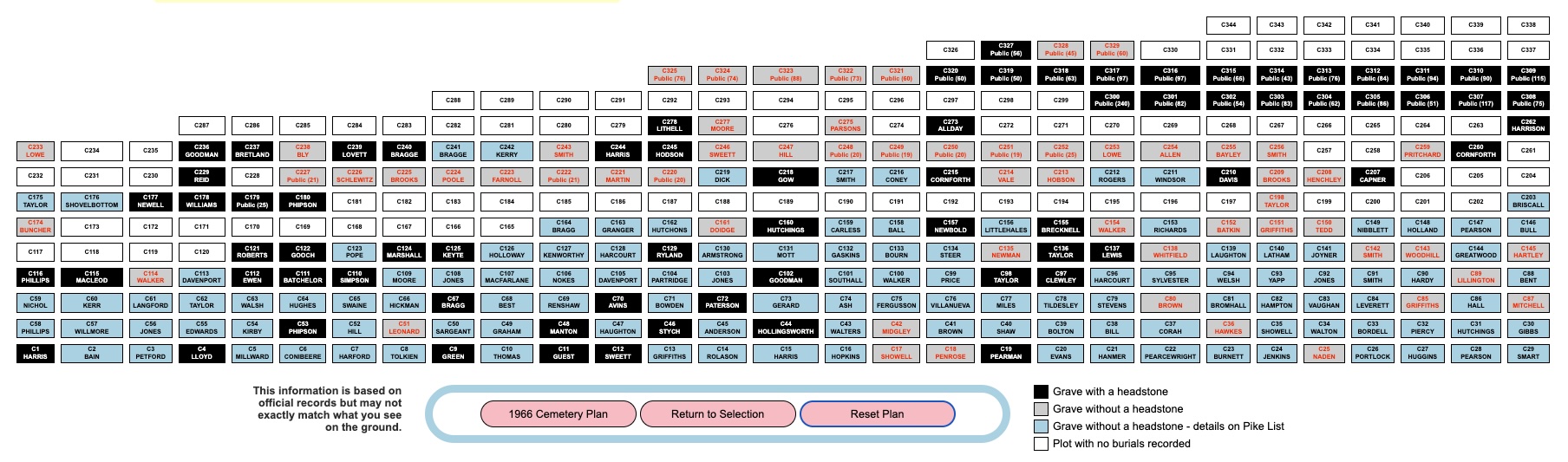
NEW GRAVE FINDER
Search for the person you are looking for in ‘Burial Records’ – you can search by surname, initial, year of death, and cemetery.
Note down the cemetery, section, and grave number they are buried in.
Go to ‘Grave Finder’ and use the drop down to select the section in the cemetery.
You will see the graves – find the number and click on it.
Any records and inscriptions will pop up on the screen.
Warstone Lane Cemetery
The Warstone Lane Cemetery opened in 1848 as a privately owned **Church of England cemetery** to serve the city’s growing population. Located in the Jewellery Quarter, it reflects Victorian burial practices and the rise of urban cemeteries designed to accommodate expanding industrial cities. Warstone Lane is compact and formal in layout, featuring traditional graves, vaults, and catacombs. Notable burials and memorials include members of the **Chance glass family**, including a man lost in the **Titanic**, commemorated on the family grave, and **Harry Gem**, co-inventor of lawn tennis. Gothic-style monuments and ornate headstones contribute to the cemetery’s architectural interest, and the site is now **Grade II* listed** for its historical and cultural significance. Although the cemetery is closed to the purchase of new graves, burials can still occur where existing rights are held and space remains, so occasional interments continue. In addition to its heritage value, Warstone Lane Cemetery functions as a small urban wildlife habitat, preserving mature trees, flora, and fauna that have established themselves over decades.